Blog

Educated-Inspired-Connected at UoH

I hail from a small village namely Ramula Banda, which is located in Nalgonda district, Telangana state where I was able to live very close to nature. Since childhood, I have tried to understand natural surroundings in my own way. In fact, nature has been the main motivation for me taking up research as a career. I strongly believe that for every research problem, nature holds a solution, but often we ignore it. This is why I feel it is worth studying the fundamentals of natural sciences in greater depth. I consider nature as my first Guru in making me think of myself, while my parents (only visible Gods in my world) taught me the fundamentals of life. In school, my education progressed with the help of many teachers, but it was learning the fundamentals of science after entering university which really formed the basis for my scientific career.

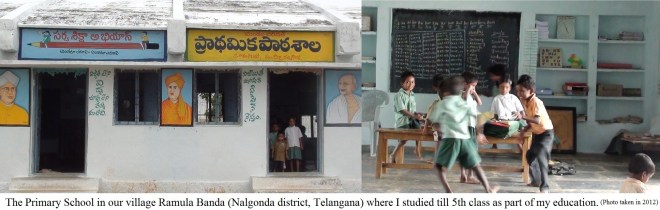
I began my education at Govt. Primary School in our village. Later, to continue my secondary high school education, I stepped towards nearest town Nalgonda from our village as a day scholar. Despite several difficulties, I have successfully finished my X standard with 93% in Telugu medium. Though I initially resisted, to achieve my goal of becoming scientist, I have decided to change my medium to English as most of the research in sciences is expressed and communicated through English language which is common platform for all global scientists.

Along with my academics, I had participated and won almost all literature activities such as essay writing and quiz competitions at school and district level. These helped me a lot at university level especially in winning science quiz competitions and during write-ups to research internships and PhD applications.
UoH2

I completed my Intermediate (XI-XII standard) Education (M.P.C) in English medium with the help of several English to Telugu translation dictionaries and Telugu medium academic books for understanding the concepts. Though it is difficult, my desire to become a scientist made me to do anything and everything to overcome these language difficulties.

After Intermediate, I have decided to join in a research oriented interdisciplinary program in Basic Sciences when all my friends were joining in Applied Sciences (Engineering) as I realized that Basic Science is the backbone of Applied Science and its knowledge at early stage helps me to understand the surrounding nature in a more fundamental way leading to daily life applications oriented interdisciplinary research in future.

I got admitted to Integrated MSc in Physics program at University of Hyderabad through IIT-JEE rank in 2009 with DST – INSPIRE Scholarship for 5 years during 2009-14. This is one of the best things happened in my life. These five years were the most exciting time of my life. The interdisciplinary approach to the Integrated Program at UoH has helped me a lot. It is the place where I got an opportunity to study different streams in science and decide on which field to specialize. The course was planned in such a way that with basic training in all disciplines and further proper specialization in a particular discipline in later years, a student could get proper foundation and training to contribute effectively as a researcher in future. During initial days, it is quite common to be confused and I was no exception. But slowly I learnt and understood what my interested area is and what I want to be. Whatever I have learnt during those five years had its own contribution to what I am today.

My journey was not so easy starting from Day 1 at university level. I was the only student in our class who finished entire schooling in Telugu medium. But I was not disappointed as I strongly decided to do anything and everything to overcome language difficulties in order to achieve my goal of becoming good scientist. During this process, the help I received from my friends, teachers and IT lab at CIS to improve my language skills is unforgettable.

Like many rural students, I also had to undergo cultural clash due to my village background and an entirely different cosmopolitan environment at university. But, with each day passing by, every element of this campus taught me something new. I have slowly learnt to adjust and be part of vast diversity at UoH.

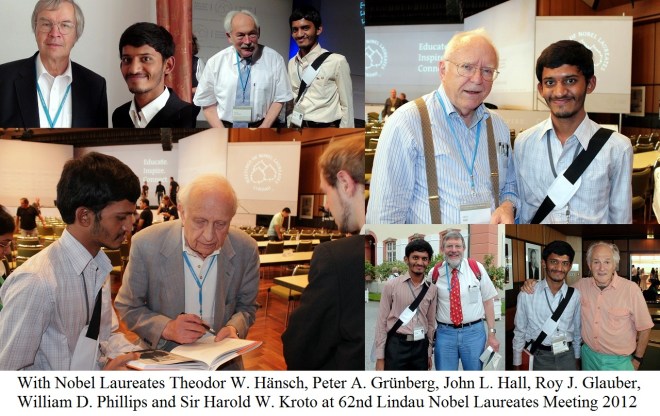
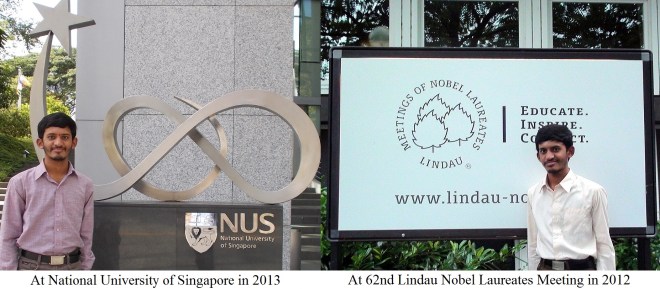
During my academic journey at UoH, I got a very rare opportunity to represent India at 62nd Lindau Nobel Laureates Meeting 2012, Germany with DST-DFG-Lindau Fellowship. Later, out of 592 young researchers from 80 different countries (18 from India) attending Nobel Laureates Meeting, the organizers chosen 6 young researchers as a video diarists based on write-up on a given topic. I was one among the 6 luckiest video diarists and the youngest video diarist ever since its introduction in Nobel Laureates Meetings at Lindau. I got this opportunity when I was just in 3rd year of my undergraduate education. Remaining 5 students from Egypt, Germany, Kenya, South Africa and USA were either senior PhD’s, Postdocs or Assistant Professors. My topic was what science and research are achieving in developing countries. Three short videos were published as part of it. My first video on Establishing friendships at Lindau will be very important was published in the opening ceremony of 62nd Lindau Nobel Laureates Meeting in the presence of 27 Nobel Laureates, Presidents, Prime Ministers, VIP’s from several countries;  and 592 young researchers from 80 different countries. Later, Easy Journaling magazine placed me at 9th in ten of the Most Creative Journal Keepers and Nature Blog published my article titled Science Mentoring: A Lindau Attendee’s Experience.
UoH3

I have also participated in Vigyan Jyoti Shibir Camp (organized by JNCASR & KVPY at IISc Bangalore) and Second Science Conclave (organized by IIIT Allahabad) in 2009; Asian Science Camp (organized by HBCSE-TIFR Mumbai) and Radio Astronomy Winter School (organized by NCRA-TIFR & IUCAA Pune) in 2010; and School for Accelerator Science and Technology (jointly organized by KEK (Japan), CERN (Europe), IIT-Bombay, TIFR, VECC, IUAC and SAMEER) in 2012.

During my research journey at UoH, I have worked on series of different projects related to light matter interaction at different time scales (nano, pcio and femtosecond regimes) under the guidance of Prof. D. Narayana Rao at Laser Lab along with regular academics, during summer and winter vacations. During my project, the help I received from Dr. H. Sekhar and other PhD students of DNR Lab is simply unforgettable.

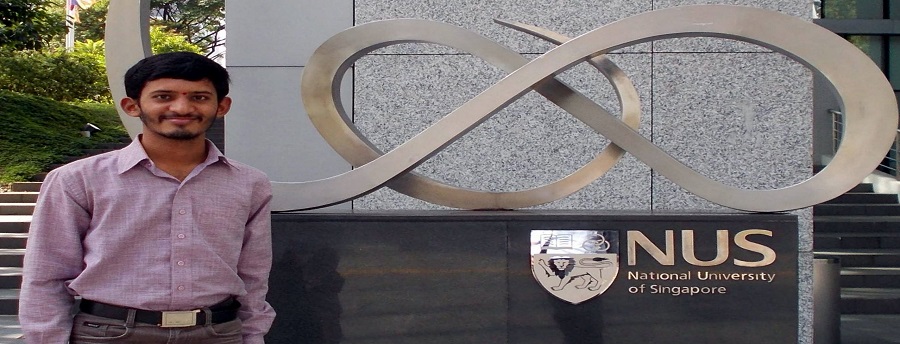
Additionally, I also got an opportunity to work on a research internship at Femtosecond Laser Spectroscopy Lab at Department of Physics and Graphene Research Center of Faculty of Science in National University of Singapore during May – July, 2013 with full fellowship under the guidance of Prof. Ji Wei.

Till now, I was credited with two research papers in reputed scientific research journals and four in conference proceedings.
UoH4

Throughout my university education, I have been a keen participant in extra-curricular activities. I thoroughly enjoy the challenges that these activities have and this has helped me in developing my interpersonal and organizational skills with an increased sense of self-confidence. I undertook various leadership roles at the university like class representative, convener, placement coordinator and volunteer for several organizations that gave me ample exposure to understand many real life situation in a practical way.

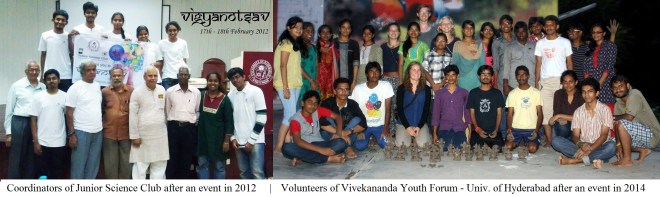
Along with academics, I worked as a convener of Junior Science Club (affiliated to Indian Physics Association) for first 3 years promoting and developing scientific temper among university community by organizing several activities related to science that includes scientific talks by students and professors, documentaries, debates, quizzes, brain teasers and science fests like Vigyanotsav. I have also actively participated in social service as I believe the ultimate aim of science is to serve the society. In 2013, I have started Vivekananda Youth Forum along with two M.Tech friends and worked for next 2 years promoting selfless service within the university community by organizing several activities.
UoH5

It is always refreshing to remember Junior Science Club and Vivekananda Youth Forum organizations that got immense love and support from all sections of the UoH community and people did find it as a voluntary forum where they can join irrespective of their all other backgrounds, get exposed to and contribute their bit towards promoting scientific temper and selfless service within the university community and national at large scale. Of course, I learnt a lot in the process.

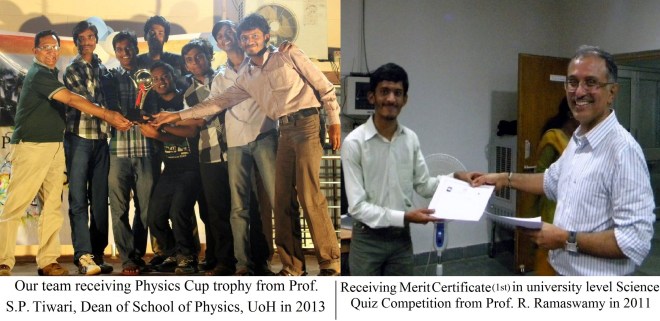
I have also participated in sports and science quiz competitions. Our team won a university level Science Quiz competition in 2011 and in the same year went to finals in Mimamsa 2011, a national level Science Quiz organized by IISER Pune.
UoH6

Though all professors at UoH are expert in their chosen areas of specialization and significantly contributed to my growth as a young researcher, the four pillars to my success – Prof. D. Narayana Rao, Prof. K.P.N. Murthy, Prof. V. Kannan and Prof. R. Ramaswamy who inspired me and motivated me towards scientific research especially during the initial days of my IMSc course at university is unforgettable.

Before finishing my course at UoH in 2014, I received selection offers from 23 universities (applied 25) from 8 different countries (Brazil, Canada, Germany, Italy, Japan, Singapore, UK and USA) for PhD in Nanomaterials related fields with full fellowship. But I decided to decline them and go for more specialized research areas like random lasers instead of already well developed research areas like nanomaterials. I feel no regret as the scientific world is always full opportunities for young researchers and open for new ideas.

In my university life, I got several opportunities to meet so many new friends from more than 80 different countries worldwide and from almost all states within India at different national and internal platforms. I established good contacts with them and made lot of friends as I believe the friendship I get at this level is going to be the basic platform for interdisciplinary and collaborative research in future in the process of finding the hidden secrets of nature.

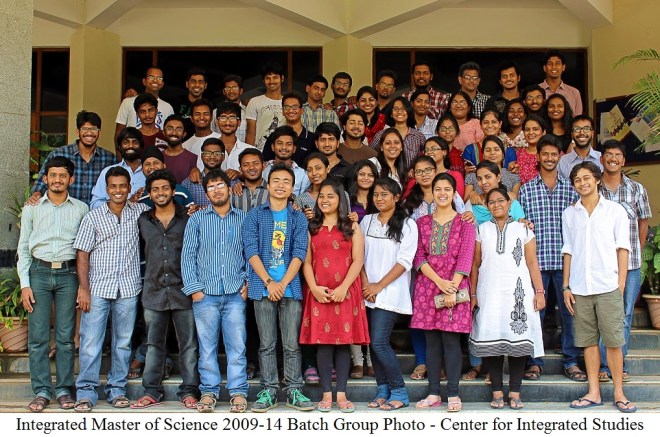
Below picture is group photo of my Integrated MSc-mates. We studied, played and did everything altogether for five golden years of my life.
UoH7

UoH is rightly called ‘Mini India’ with vast diversity in culture, tradition, ideologies, and is perfect example of coexistence of altogether. It is so full of learning. We can see green everywhere and the campus is full of life. On the university campus we could see students from all over India learning together about each other’s culture, lifestyle and festivals etc. I must admit that UoH has one of the best culture of close and healthy interaction with faculty and administration and openness to support various initiatives to nurture other forms of learning for students. Everyone falls in love with natural beauty of the campus and I was no exception.

Finally, UoH gave me an excellent platform to interact with many students from all over India and explore my inner strengths, to do lots of experiments with real life situations, to learn, unlearn and relearn many things. I have got amazing lifetime friends and teachers during my stay at the UoH and feel very privileged about it. I consider the purpose of my life is fulfilled, once I achieve my goal of becoming a good scientist, taking science to remote villages and developing people’s awareness of what can be achieved through science.

I was educated, inspired and connected at UoH. So, my past, present and future success is undoubtedly dedicated to UoH!

This article is originally published at UoH Herald: Educated, Inspired and Connected at UoH!
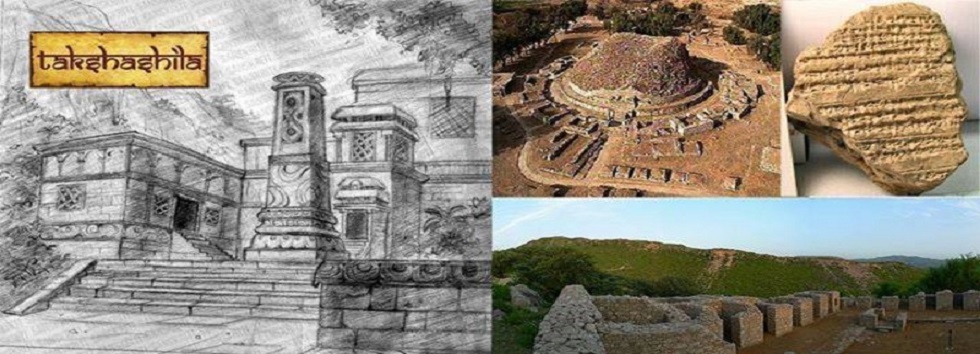
Takshashila: World’s First University

India has a long and venerable history in the field of higher education. In ancient times, the country was known to have been home to the oldest formal universities in the world. More than 2700 years back a huge university existed in that ancient India where over 10,500 students from all across the world came for higher studies.

This was the Takshila/TakshaShila university of ancient India (700 BC). During its times this university was the IIT and MIT of the world. During the 800 years that Takshila was operational, it attained great fame. The University consisted of

  • 300 lecture halls with stones benches for sitting.
  • Laboratories.
  • Observatory called the Ambudharaavlehi for astronomical research.
  • Massive Library called Dharma Gunj or Mountain of Knowledge.
  • consisting of 3 buildings: Ratna Sagar, Ratnodavi and Ratnayanjak.

The Vayu Purana traces the start of Takshila to Taksha, son of Bharata and is also mentioned in Mahabharata, citing Dhaumya as one of the Acharyas. There are several mentions of this University in the Buddhist Jataka Tales. Chinese travellers like Fa Hian (Faxain) and Huien Tsang (XuanZang) also speak of Takshila in their writings.

COURSE AND CURRICULUM:

The university offered 68 different courses in various field such as science, mathematics, medicine, politics, warfare, astrology, astronomy, music, dance, religion, vedas, grammar, ayurveda, agriculture, surgery, commerce, futurology, and philosophy were taught by nearly 2000 master-teachers. There were even curious subjects like the art of discovering hidden treasure, decrypting encrypted messages, etc. The Vedas and the Eighteen Arts, which included skills such as archery, hunting, and elephant lore, were taught, in addition to its law school, medical school, and school of military science. Takshila was specialized in the study of medicine.

ADMISSION CRITERIA:

Students were admitted to this university at the age of 16 after they had completed their primary education at home (until the age of eight), and secondary education in the Ashrams (between the ages of eight and sixteen). Every single graduate who passed out of this university would become a well sought after scholar all across the subcontinent! Admission into this university was purely based on merit. The students would opt for electives and then would do indepth study and research into their field of choice. Entrance exam to Takshila was very difficult and only 3 out of every 10 students passed the admission test.

DIVERSITY!

More than 10,500 students from all over the world studied here. The campus accommodated students who came from as far as Babylonia (Iraq), Greece, Egypt, Syria, Asia Minor (Turkey), Arabia, and China.

AUTONOMOUS UNIVERSITY!

No external authorities like kings or local leaders subjected the scholastic activities at Takshashila to their control. Each teacher formed his own institution, enjoying complete autonomy in work, teaching as many students as he liked and teaching subjects he liked without confirming to any specific centralized syllabus. Study terminated when the teacher was satisfied with the student’s level of achievement. In most cases, the schools were located within the teachers’ private houses, and at times students were advised to quit their studies if they were unable to fit into the social, intellectual and moral atmosphere there. The teachers were exempted from the payment of taxes and they were given ample amounts of money on the the occasion of various sacrifices and rituals as well.

NO ADMISSION FEE!

Knowledge was considered too sacred to be bartered for money, and hence any stipulation that fees ought to be paid was vigorously condemned. Financial support came from the society at large, as well as from rich merchants and wealthy parents. Though the number of students studying under a single Guru sometimes numbered in the hundreds,teachers did not deny education even if the student was poor; free boarding and lodging was provided, and students had to do manual work in the household. Paying students like princes were taught during the day; non-paying ones, at night. Guru Dakshina was usually expected at the completion of a student’s studies, but it was essentially a mere token of respect and gratitude – many times being nothing more than a turban, a pair of sandals, or an umbrella. In cases of poor students being unable to afford even that, they could approach the king, who would then step in and provide something. Not providing a poor student a means to supply his Guru’s Dakshina was considered the greatest slur on a King’s reputation.

EXAMS NO CONSTRAINT!

Examinations were treated as superficial, not considered part of the requirements to complete one’s studies. The process of teaching was thorough- unless one unit was mastered completely, the student was not allowed to proceed to the next. No convocations were held upon completion, and no written degrees were awarded, since it was believed that knowledge was its own reward. Using knowledge for earning a living or for any selfish end was considered the ultimate Disaster.

ALUMNI: Takshashila’s famous researchers and teachers include

  1. Panini, the great grammarian of Sanskrit, to whom Prof. Noam Chomsky of MIT attributes the origin of linguistics. He was an expert in language and grammar and authored one of the greatest works on grammar ever written called Ashtadhyayi. Ashtadhyayi means eight chapters and is more complicated and at the same time highly technical and specific defining the features and rules of Sanskrit grammar, like how we have modern day books on computer programming languages like C/C++.
  2. Charaka, the famous ancient Indian ayurvedic physician was a product of Takshashila university. He originally authored the Charaka Samhita (simplifying an even older ayurvedic work called the Agnivesha Samhita) which along with Sushrutha Samhita, Ashtanga Sangraha and Ashtanga Hrudayam forms the root of modern Ayurveda. Charaka said, ‘A physician who fails to enter the body of a patient with the lamp of knowledge and understanding can never treat diseases’ .
  3. Jivak, was a doctor and an expert in pulse reading (understanding the health status of the body by just listening to the person’s pulse!). He studied Ayurveda in Takshashila University for seven years. His areas of specialization was Panchakarma, Marma and Surgery.Jivak was the personal physician of Buddha and also cured the Nadi Vran of Buddha! He also worked with the great classic beauty Amrapali and ensured that she retained her youthful countenance and performed many amazing operations on her using only Marma points and surgical procedures! He also invented a cure for Filariasis. There are over 15000 handwritten manuscripts of Jivak’s expertise passed on by generations to their children and are still preserved in India even today.
  4. Chanakya, the great political master also called Kautilya/Vishnugupta who not only authored the world’s finest work till today on political duties, statecraft, economic policies, state intelligence systems, administrative skills and military strategy, called the Artha Shastra which consists of 15 books, but who also guided Chandragupta Maurya as a mentor who founded the Great Mauryan Empire, and also served as the prime minister of the Mauryan Empire! In fact Chanakya is known to be the third most famous management consultant in India after Krishna and Shakuni.
  5. Vishnu Sharma , the author of the great book that teaches the art of political science in the form of simple beautiful stories called the Pancha Tantra (meaning the five techniques). It is said that Vishnu Sharma wrote these stories in order to convert three dumb princes of a king into able political administrators within a span of six months!
  6. Jotipala, son of the Purohita of the king of Banaras, returned from Takshashila with great proficiency in archery or military science and was later appointed commander-in-chief of Banaras.
  7. Prasenajit, the enlightened ruler of Kosala, who is intimately associated with the events of the time of the Buddha.

Takshila’s prosperity resulted from its position at the junction of three great trade routes. In the second half of the 5th century, it was severely damaged by Hephthalite invasions; during the 7th century it was gradually abandoned by its inhabitants. Excavations begun in 1913 finally gave the world a peak into the best minds in Indian history. Takshila was listed by the UNESCO as one of the World Heritage Sites in 1980.

As an ancient sanskrit quote says “स्वगृहे पूज्यते मूर्खः स्वग्रामे पूज्यते प्रभुः। स्वदेशे पूज्यते राजा विद्वान्सर्वत्र पूज्यते॥” (A fool is worshiped at his home. A chief is worshiped in his town. A king is worshiped in his kingdom. A knowledgeable person is worshipped everywhere)

References:

  1. Takshila University
  2. Universities in ancient India by D. G. Apte
  3. Taxila – UNESCO

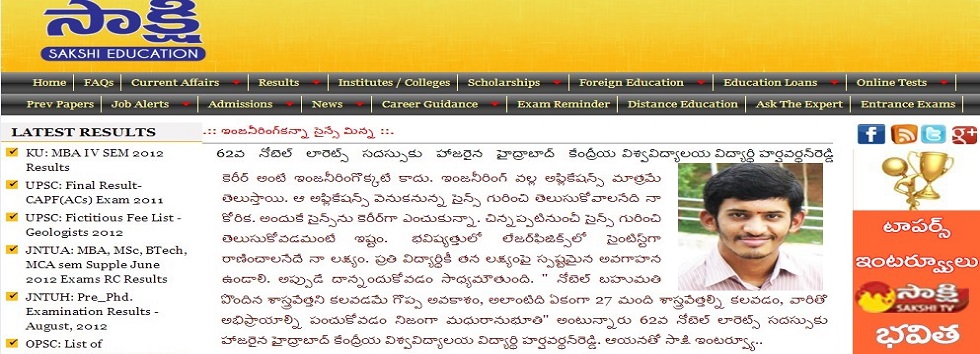
ఇంజనీరింగ్‌కన్నా సైన్సే మిన్న!

కెరీర్ అంటే ఇంజనీరింగొక్కటే కాదు. ఇంజ‌నీరింగ్ వ‌ల్ల అప్లికేషన్స్ మాత్రమే తెలుస్తాయి. ఆ అప్లికేషన్స్ వెనుకనున్న సైన్స్ గురించి తెలుసుకోవాలనేది నా కోరిక. అందుకే సైన్స్‌ను కెరీర్‌గా ఎంచుకున్నా. చిన్నప్పటినుంచీ సైన్స్ గురించి తెలుసుకోవడమంటే ఇష్టం. భవిష్యత్తులో లేజర్‌ఫిజిక్స్‌లో సైంటిస్ట్‌గా రాణించాలనేదే నా లక్ష్యం. ప్రతి విద్యార్థికీ త‌న ల‌క్ష్యంపై స్పష్టమైన అవ‌గాహ‌న ఉండాలి. అప్పుడే దాన్నందుకోవ‌డం సాధ్యమౌతుంది. ” నోబెల్ బ‌హుమ‌తి పొందిన శాస్త్రవేత్తని క‌ల‌వ‌డ‌మే గొప్ప అవ‌కాశం, అలాంటిది ఏకంగా 27 మంది శాస్త్రవేత్తల్ని క‌ల‌వ‌డం, వారితో అభిప్రాయాల్ని పంచుకోవ‌డం నిజంగా మ‌ధురానుభూతి” అంటున్నారు 62వ నోబెల్ లారెట్స్ సదస్సుకు హాజ‌రైన హైద్రాబాద్ కేంద్రీయ విశ్వవిద్యాల‌య విద్యార్థి హర్షవర్థన్‌రెడ్డి. ఆయ‌న‌తో సాక్షి ఇంటర్వ్యూ..

నోబెల్ సదస్సుకు వెళ్లే అరుదైన‌ అవకాశం మీకు వ‌చ్చింది. దీని పై మీ స్పంద‌న‌ ?
నోబెల్ బ‌హుమ‌తి పొందిన శాస్త్రవేత్తల్ని క‌లుసుకోవాల‌ని ప్రతీవిద్యార్థి ఉవ్విళ్లూర‌తాడు. అలాంటిది 27 మంది శాస్త్రవేత్తల్ని క‌లుసుకోవ‌డ‌మంటే నిజంగా అదో అద్భుతం. సంతోషంతో నాకు మాట‌లు రావ‌డం లేదు. జర్మనీలో నిర్వహించే ఈ సమావేశానికి ప్రపంచంలోని 70దేశాల నుంచి 580 మంది విద్యార్థులను ఎంపికచేస్తారు. భార‌త దేశం నుంచి ఎంపికైన‌ 18 మందిలో నేను ఒక‌ణ్ణి. హైద్రాబాద్ కేంద్రీయ విశ్వవిద్యాల‌యంలో భౌతిక శాస్త్రవిభాగంలో ఇంటిగ్రేటెడ్ ఎంఎస్సీ చ‌దువుతున్ననాకు ఈ అవ‌కాశం రావ‌డం చాలా ఆనందంగా ఉంది.

మీ గురించి చెప్పండి ?
మాది నల్గొండ జిల్లా రాములబండ. ఉపాధ్యాయుడు, అమ్మ గృహిణి. ప‌దోత‌ర‌గ‌తి వ‌ర‌కూ సొంత జిల్లాలోనే చదువుకున్నాను. నెల్లూరులోని ఓ ప్రైవేటు కాలేజీలో ఇంట‌ర్‌ చదివాను. తర్వాత హైదరాబాద్ సెంట్రల్ యూనివర్సిటీలో ఎంఎస్సీ(ఇంటిగ్రేటెడ్) ఫిజిక్స్‌లో చేరాను. ప్రస్తుతం ఎంఎస్సీ ఇంటిగ్రేటెడ్ ఫిజిక్స్ నాలుగో సంవ‌త్సరం చ‌దువుతున్నాను.

జర్మనీలో నిర్వహించే ఈ నోబెల్ సదస్సుకు విద్యార్థులను ఎవ‌రు ఎంపిక చేస్తారు ?
భారత సైన్స్ అండ్ టెక్నాలజీ విభాగం, జర్మనీ రీసెర్చ్ ఫౌండేషన్ కలిసి సదస్సుకు వెళ్లే విద్యార్థులను ఎంపికచేస్తాయి. అందుకు ప్రతీ సంవ‌త్సరం నోటిఫికేష‌న్ విడుద‌ల చేస్తాయి. దానికి నేను ద‌రఖాస్తు చేశాను. చిన్నప్పటినుంచీ సైన్స్‌పై ఆసక్తి ఉండడం, ఫిజిక్స్‌లో పలు సృజనాత్మక ప్రయత్నాలు చేయడంతో సెంట్రల్ యూనివర్సిటీ నుంచి నన్ను నామినేట్ చేశారు.

జర్మనీ స‌ద‌స్సు ద్వారా మీరు తెలుసుకున్న విష‌యాలు చెప్పండి?
సైన్స్ సబ్జెక్టులో ఏదైనా ఓ అంశాన్ని తీసుకుని దానిపైనే ప్రధానంగా దృష్టిసారించి పరిశోధన చేస్తేనే విజేతగా నిలుస్తారని 2011లో నోబెల్ బహుమతి పొందిన ఓ సైంటిస్ట్ చెప్పారు. రానురాను ప్రపంచంలో విద్యుత్తుశక్తి అవసరాలు అమాంతం పెరిగిపోతాయని, దానినుంచి బయటపడేందుకు శక్తివనరులను కాపాడుకుని సౌరశక్తి వ్యవస్థను వద్ధిచేసుకోవాలని సైంటిస్టులంతా తమ ప్రసంగాల్లో వెల్లడించారు. సైన్స్ పరిశోధన అనేది ల్యాబ్‌లో జరగాలా? ప్రకృతి మధ్య జరగాలా? అని నేనడిగిన ప్రశ్నకు సమాంతరంగా జరగాలని అవార్డుగ్రహీతలు వివరించారు. భౌతికశాస్త్రలో ప్రతి ఒక్కటీ క్వాంటం ఫిజిక్స్‌పైనే ఆధారపడి ఉంటుంది. అలాంటప్పుడు దీనికి ప్రత్యామ్నాయం ఉందా? అనే దానికి ఇప్పటికిప్పుడు ప్రత్యామ్నాయాలు సృష్టించడం సాధ్యంకాద‌ని మీలాంటి విద్యార్థులు అంద‌రూ ప‌రిశోథ‌న రంగంలో ప్రవేశిస్తే అది క‌చ్ఛితంగా సాధ్యమ‌వుతుంద‌న్నారు.

పరిశోధన రంగాల్లో జర్మనీ ప్రఖ్యాతి చెంద‌డానికి కార‌ణాలు ఏమిటి?
పరిశోధన రంగానికి జర్మనీలో ప్రాధాన్యతెక్కువ. సైన్స్ ల్యాబరేటరీలు పూర్తిస్థాయి సౌకర్యాలతో ఏప్రయోగం చేయడానికైనా వీలుగా సైంటిస్టులకు వెన్నుదన్నుగా ఉంటాయి. మనదగ్గర ఏదైనా ప్రయోగం చేయాలంటే అందుబాటులో ఉన్న పరికరాలతో ప్రయోగాలుచేస్తారు. కాని జర్మనీలో సైంటిస్టులు తమ పరిశోధనలకు కావలసిన పరికరాలను అప్పటికప్పుడు తయారుచేసుకుంటారు. అక్కడ పరిశోధనాశాలలన్నీ పరిశ్రమలతో పక్కపక్కనే అనుసంధానమై ఉంటాయి. ఆయా ప్రొఫెస‌ర్లు చేసే ప‌రిశోథ‌న‌ల‌కు ప‌రిశ్రమ‌లు అండ‌గానిలుస్తాయి. వారి ప‌రిశోథ‌న ఫ‌లితాల‌ను జ‌న‌బాహుళ్యంలోకి తీసుకువ‌చ్చేందుకు ఆర్థిక స‌హాయాన్ని అంద‌జేస్తాయి. ప‌రిశోథ‌న‌శాల‌ల్లో మౌలికసదుపాయాలు ఆధునికంగా ఉంటాయి.

ఈ స‌ద‌స్సు విద్యార్థుల‌కు ఏవిధంగా ఉప‌యోగ‌ప‌డుతుంద‌ని మీరు భావిస్తున్నారు ?
విద్యార్థులంద‌రూ త‌మ‌కు న‌చ్చిన రంగంలో ఏదో సాధించాల‌నే ల‌క్ష్యంతో ఉంటారు. అయితే వారికి స‌రైన ప్రోత్సాహం ల‌భించ‌క పోవ‌చ్చు. మార్గ నిర్దేశం చేసేవారు లేక‌ లక్ష్యంపై స్పష్టత కొరవడి ఎంచుకున్న దారిలో నడవలేకపోతున్నారు.అలాంటి విద్యార్థులకు ఈ స‌ద‌స్సు మేథావులతో కలిసి మాట్లాడి వారి అభిప్రాయాల్ని పంచుకొనే అరుదైన అవకాశాన్ని క‌ల్పిస్తోంది. ఇది క‌చ్ఛితంగా దారితెలియ‌ని విద్యార్థికి దిక్సూచిలా ఉప‌యోగ‌ప‌డుతుంది. త‌త్ఫలితంగా ఆయా విద్యార్థులంద‌రూ త‌మ ల‌క్షాల్లో విజ‌యం సాధించేందుకు తోడ్పడుతుంది. నావరకు… ఫిజిక్స్‌రంగంలో నేనేం సాధించాలో పూర్తి స్పష్టత వచ్చింది. ఫిజిక్స్‌లో నోబెల్ బహుమతి సాధించడం ఆషామాషీకాదు. ఎంతోకష్టపడి, ఎన్నోఏళ్లు శ్రమిస్తేనే అది సాధ్యమ‌వుతుంది. నేనూ ఎప్పటికైనా ఆ స్థాయిలో ఉండాల‌ని నిర్ణయించుకున్నాను. ప‌రిశోధ‌న పై నా ఆస‌క్తి ఈ స‌ద‌స్సుకు హాజ‌ర‌వ్వడంతో మ‌రింత పెరిగింది.

మీ జీవిత ల‌క్ష్యం?
పీహెచ్‌డీ చేసి శాస్త్రవేత్తగా ప‌రిశోధ‌న‌లు చేయాలి. ప్రస్తుతం సైన్స్‌లో జరుగుతున్న పరిశోధనల వెనుక లేజర్ ఫిజిక్స్ పాత్ర చాలా ఉంది. లేజర్ ఫిజిక్స్‌పై ప్రస్తుతం ప్రపంచవ్యాప్తంగా అనేక పరిశోధనలు జరుగుతున్నాయి. ముఖ్యంగా లేజర్ ఫిజిక్స్ సాయంతో సోలార్ విద్యుత్తు సామర్థ్యాన్ని పెంచడానికి అనేక ప్రయత్నాలు జరుగుతున్నాయి. భవిష్యత్తులో లేజర్‌ఫిజిక్స్‌లో కొత్త సూత్రాలు కనిపెట్టడమే ధ్యేయం.

You can find my original interview at: http://goo.gl/984egr

My NUS Internship Experience

The morning blue skies of May 15th, 2013 welcomed me as I arrived on the little island that man had made in his sight though god had his own. The beautiful landscapes and the mystical buildings of the country of Singapore drove past me as I took MRT from airport to NUS. I pondered back, rewinding my calendar to March 22nd, 2013 – the day when I received the offer letter citing my application being accepted and I was to join the only eight students selected for the SIPIS summer internship program from all over India to work at the Department of Physics of the National University of Singapore for this academic year. I myself couldn’t believe that I was going to spend the summer of 2013 in one of the most awesome cities of the world, Singapore and primarily in NUS, which is amongst the world’s leading universities and one of the best in Asia.

Each and every moment, from landing at Changi Airport and setting my watch two and a half hours ahead of IST to reverting it exactly 60 days later, was a memorable one.

It is always a special moment when you meet the professor who gave you the opportunity to work with him, for the first time. On the very first day, my supervisor asked “How is Singapore?” and my response was ‘Singapore is inspiring!’

On next day, he gave bundle of research papers and asked me to give a presentation on it following week. My presentation on May 21st, 2013 followed by discussions with him actually shaped my entire internship. I was given a project to work on “Nonlinear optical properties of Graphene” My project got clearer with every passing day.  I liked their strategy of giving projects to summer interns. It tests all your theoretical, computational and experimental skills of handling a research problem.  Starting with theory followed by experiments helped me to understand theoretical concepts in a practical way. I had regular presentations and meetings with my supervisor which helped me to improve my understanding further.

The diverse culture and cleanliness at NUS was instantly impressive. The people were nice and helpful, and the weather was awesome!

Many students have the misconception that research purely means sitting in a lab for prolonged hours and getting results. That is not even close to the actual experience I had during my entire internship.

The willingness to share and gain knowledge together as a group is probably that had bound the research students of the laboratory together. The work being conducted was seen being implemented practically.

July 2nd, 2013, which surprisingly coincides with my previous visit to Lindau Nobel Laureates Meeting, Germany during 1st – 6th July 2012 last year, where I again got an opportunity to attend Nobel Laureates lecture series by Alan J. Heeger and Yuan T. Lee but this time at University Cultural Centre, NUS.

I realised, there was so much to learn, to observe and to do. We did. The culture, the food, the language, and the people- everything was new. Days passed very quickly.

Besides working in the lab, there was an equally exciting life outside.  During weekends, we all left to look around the little country Singapore and visited places like Little India, Chinatown, Marina Bay Sands and Sentosa Island. I learnt the way the country’s system worked, how organized and systematic and law-abiding the citizens of Singapore were. The structured, flawless and the most efficient was definitely the country’s public transportation facility- a real class apart from the rest of the world.

After my successful internship I now strongly believe in NUS’s mission statement — to transform the way people think and do things through education, research and service. New friends, inspiring research supervisor, a rich research experience, loads of memories and gigabytes of photos- that’s what I bring back from an awesome summer spent in Singapore.

The roads looked longer; the bus stands looked lonelier as we walked back for the very last time. I bid adieu to little nation but it had definitely sent me back home with many a sweet memories that I will cherish for years and years to come.

I feel I am ignited. Overall, it was a wonderful experience working together with students from 3 most emerging nations in science in Asia i.e. Chinese, Japanese and Indians. I so miss it!

Happy Birthday Song in Sanskrit

This song is a composition of Swami Tejomayananda, Chinmaya Mission.

In Sanskrit

जन्मदिनमिदम् अयि प्रिय सखे
शंतनोतु हि सर्वदा मुदम् ।।

प्रार्थयामहे भव शतायु:
ईश्वर सदा त्वाम् च रक्षतु ।।

पुण्य कर्मणा कीर्तिमार्जय
जीवनम् तव भवतु सार्थकम्

In English

janma-dinam-idham ayī prīya sakhe |
shantanotu te sarvadā mudam ||

prārthayāmahe bhava shatāyushī |
īshvaras-sadā tvām cha rakshatu ||

punya karmanā kīrtimārjaya |
jīvanam tava bhavatu sārthakam ||

Line-to-Line explanation of this song:

अयि प्रिय सखे जन्मदिनमिदम् शंतनोतु हि
ayi priya sakhe, janmadinam idam sham tanotu hi|
hey dear friend, let this birthday bring peace to you

शतायु: भव
satayu: bhava|
let you live 100 years

ईश्वर: त्वाम् च सदा रक्षतु
eshwara: twam ca sarvada rakshtu.|
always, may God protect you also.

पुण्य कर्मणा कीर्तिमार्जय
punya karmana keerthim arjaya|
gain glory through meritorious acts.

जीवनम् तव भवतु सार्थकम्
jeevanam tava bhavatu saarthakam|
let your life be fruitful.

इति सर्वदा मुदम् प्रार्थयामहे
iti sarvada mudam prarthayamhe |
thus we all pray happily always.

Meaning of this song in English: O dear friend! May this birthday bring auspiciousness and joy to you forever. Indeed, we all pray for your long life. May the Lord always protect you. By noble deeds, may you attain fame, and may your life be fulfilled.

The Power of Global Meditation

If we want world peace it is up to us to make it manifest. The whole world is coming to the realisation that everything in the universe is connected. That our thoughts have real physical implications on our lives and the lives of those around us. No matter what Colour, Religion, or Country you are from, we are all Family. The sooner we embrace this Oneness we Will bring peace upon earth.

In 1978 what is known as the “Maharishi Effect” took a group of 7000 individuals over the course of 3 weeks and had them all meditating on thoughts of love and peace. They were able to radiate loving energy which reduced global crime rates, violence, and casualties during the times of their meditation by an average of 16%.

Suicide rates and automobile accidents also were reduced with all variables accounted for. In fact, there was a 72% reduction in terrorist during the times at which this group was meditation.

Almost 50 studies have been done further confirming the benefits of global meditation and it’s direct impact on everything in the world, even so far as to have the results published in the Journal of Crime and Justice in 1981. We know meditation has endless health and psychological benefits, but it is now being explored by politics and sociology because of its undeniable energetic impact.

Everything is energy, including your thoughts. These thoughts have a radiant quality that ripple through the consciousness field and energetically effect all things around you. If you want to change the state of society, it starts right now by finding peace and love within yourself.

“I think the claim can be plausibly made that the potential impact of this research exceeds that of any other ongoing social or psychological research program. It has survived a broader array of statistical tests than most research in the field of conflict resolution. This work and the theory that informs it deserve the most serious consideration by academics and policy makers alike.” — David Edwards Ph.D., Professor of Government, University of Texas at Austin.

The Glory of Sanskrit Language

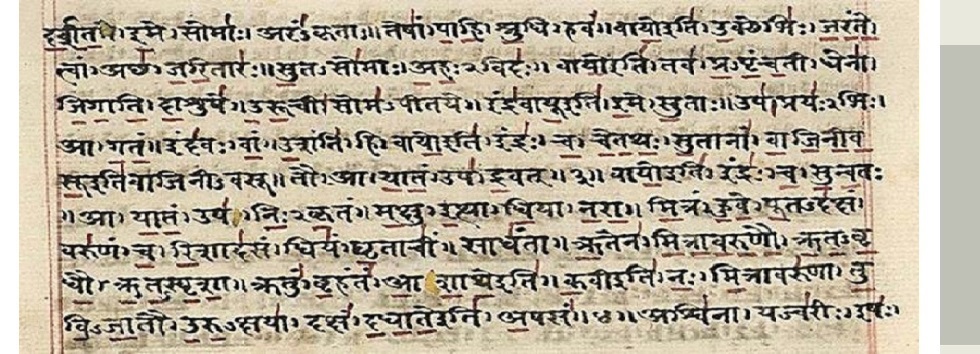
Sanskrit is not only the most ancient language of India but of the whole world and all other languages of the world have its roots in this language e.g English word “mathr” became “mother”, “brathr” became “brother”, “gya-mti” became “geometry”, “tri-kon-mti” became “trigonometry” and so on.

“Sanskrit is the original source of all the European languages of the present day” – Mons. Dubois

“Sanskrit is the mother of all languages” – By Francois Gautier

In 1980 NASA declared it to be “The most unambiguous of all human speech and best suited for Computer processing and artificial intelligence” (link)

The fact that the same language is used for computations(Vedic mathematics, astronomy etc.), music (Gndhrv Veda), medicine(Ayurveda), programming, poetry(all major works in Sanskrit), logic(Drshn), formulas(Sulbh Sutr, astronomy and all others), politics(Arth Shastr), warrior arts(Dhnur Veda), atomic theory(Vaisheshik drshn) without using any extra symbols and diagrams make it truly amazing and incredible.

There are 54 letters in the Sanskrit alphabet. Each has masculine and feminine, shiva and shakti giving total of 108 alphabets. These are properly arranged i.e. each row of alphabets are spoken from particular part of mouth or throat or nose. Due to this scientific nature of the method of pronunciation of the vowels and consonants in the Sanskrit, every part of the mouth is exercised during speaking. This results into speakers of Sanskrit being able to pronounce words from any language.

It is said that the language of Sanskrit itself arises from these very root sounds or vibrations of the Universe. The various vowels and consonants that make up Sanskrit words represent these core sounds, known as beej. Whilst in states of deep resonance with the cosmos (in other words, while in meditation), the Rishi could perceive these beej sounds; and from this profound sense of perception, they recognized the inherent sounds of each and every thing. A Sanskrit word, then, is not randomly chosen to name something, but an actual reflection of the inherent ‘sound’ of that object, concept or phenomena. In fact, proper, or rather, perfect, pronunciation of Sanskrit words, it is told, can replicate the exact nature, or essence, of that which it is referring too. It is also told that if one’s mind was utterly pure, then upon hearing this perfectly pronounced symbol, the Sanskrit word, the image of that object, idea, etc., would immediately appear within the mind and the ‘field of understanding’ of this individual, even if they had never seen or heard of this thing or idea before. Likewise, the perfect pronunciation of a Sanskrit word has the power to manifest and/or influence that particular thing.

“Every one of its vowels and consonants has a particular and inalienable force which exists by the nature of things and not by development or human choice… it’s (Sanskrit’s) basis is universal and eternal” – Sri Aurobindo

Well-known linguists and computer-scientists have expressed the opinion that Sanskrit is the best language for use with computers.

In July 1987, Forbes magazine published news that, “Sanskrit is the most convenient language for computer software programming“.

Based on the paper by Rick Briggs, published in AI Magazine that talks about using Sanskrit in natural language processing (NLP). The idea of using natural language for computer programming is to make it easier for people to talk to computers in their native tongue and spare them the pain of learning a computer friendly language like assembly/C/Java!“. So in that way Sanskrit speakers would be almost ready made computer programmers!

Its grammar(Panini) is perfect without exceptions so you would not have sentences with ambiguous meanings. The vastness, preciseness, versatility, comprehensibility of the language can be judged from the fact that this language has 65 words to describe various forms of earth, 67 words for water, more than 50 words for lotus and more than 250 words for rainfall.

Sanskrit is phonetic language so you write what you speak and the whole aim of developing a language is wasted if we need to remember two versions, one for writing and one for speaking!

“The Panini grammar reflects the wondrous capacity of the human brain, which till today no other country has been able to produce except India“ – Sir Monier Williams

“The grammar of Panini is one of the most remarkable literary works that the world has ever seen, and no other country can produce any grammatical system at all comparable to it, either for originality of plan or analytical subtlety“ – Bilas Sarda

Unlike other crude languages where every word has different spelling and pronunciation(except few words which have same roots with poor rules for combination), here in Sanskrit you speak what you write! and every word can be broken into sub parts by using rules of Viched(separation). If you use rules of Sandhi-Viched(combination-separation) then even if you know only thousand words, you will develop your vocabulary of several thousands of words.

“We Europeans, 2,500 years later, and in a scientific age, still employ an alphabet which is not only inadequate to represent all the sounds of our language, but even preserve the random order which vowels and consonants are jumbled up as they were in the Greek adaptation of the primitive Semitic arrangement of 3,000 years ago“ – Arthur A. Macdonell

The words describe themselves! So even if you haven’t heard some word of Sanskrit before still you will be able to figure out its meaning! E.g the meaning of Sanskrit itself is superior art (Sns+Krit). So every word has meaning too.

In Optimality Theory, the hypothesis about the relation between specific and general constraints is known as “Panini’s Theorem on Constraint Ranking

Panini’s work was the forerunner to modern formal language theory (mathematical linguistics) and formal grammar, and a precursor to computing. Ref: O’Connor, John J.; Robertson, Edmund F., “Panini”, MacTutor History of Mathematics archive, University of St Andrews

Panini used the method of “auxiliary symbols”, in which new affixes are designated to mark syntactic categories and the control of grammatical derivations. This technique, rediscovered by the logician Emil Post, became a standard method in the design of computer programming languages. Ref:Kadvany, John (2007), “Positional Value and Linguistic Recursion”, Journal of Indian Philosophy 35: 587–520.

Noam Chomsky has always acknowledged his debt to Panini for his modern notion of an explicit generative grammar. In Chomsky and Morris Halle’s 1968 text The Sound Pattern of English, the authors give an implicit nod to the Ashtadhyayi by formulating their final rule “ā →   ā”, which echoes the  final Pāṇini’s final rule, “a a iti” (अ अ इति । ८ ।   ४ । ६८). (Link)

The idea of describing the structure of language with rewriting rules can be traced back to at least the work of Pāṇini, who used it in his description of Sanskrit word structure – hence, some suggest to rename BNF to Panini–Backus Form.Ref: P.Z. Ingerman (1967)

Behaghel’s law of increasing terms is also known as “Panini’s Law” after the Sanskrit grammarian.Ref: Cooper and Ross, “World order”, in Robin E. Grossman et al. (eds.), Papers from the Parasession on Functionalism, (Chicago Linguistic Society, 1975), pp. 63–111.

The chandaḥśāstra presents the first known description of a binary numeral system in connection with the systematic enumeration of meters with fixed patterns of short and long syllables.The discussion of the combinatorics of meter corresponds to the binomial theorem. Halayudha’s commentary includes a presentation of the Pascal’s triangle (called meruprastara). Pingala’s work also contains the basic ideas of Fibonacci number (called matrameru ).

Sanskrit grammar (Panini’s) is of a brevity and completeness unmatched in any grammar of any language. It takes material from the lexical lists (Dhatupatha, Ganapatha) as input and describes algorithms to be applied to them for the generation of well-formed words. It is highly systematized and technical. Inherent in its approach are the concepts of the phoneme, the morpheme and the root. His rules have a reputation for perfection — that is, they are claimed to describe Sanskrit morphology fully, without any redundancy. A consequence of his grammar’s focus on brevity is its highly unintuitive structure, reminiscent of modern notations such as the “Backus–Naur Form”. A consequence of his grammar’s focus on brevity is its highly unintuitive structure, reminiscent of contemporary machine language (as opposed to general programming languages). Its use of meta-rules, transformations, and recursion together make his grammar as rigorous as a modern Turing machine. Its ‘s grammar can be considered to be the world’s first formal system. It had a significant influence on many of the foundational ideas proposed by Ferdinand de Saussure, professor of Sanskrit, who is widely considered the father of modern structural linguistics.

Pāṇini’s approach was amazingly formal; his production rules for deriving complex structures and sentences represent modern finite state machines.

The Ashtadhyayi is the central part of Pāṇini’s grammar, and by far the most complex. It is the earliest complete grammar of Classical Sanskrit, and in fact is of a brevity and completeness unmatched in any ancient grammar of any language. It takes material from the lexical lists (Dhatupatha, Ganapatha) as input and describes algorithms to be applied to them for the generation of well-formed words. It is highly systematized and technical. Ref: Sanskrit Philosophical Commentary

Sanskrit is such intelligently structured that there are special six branches called Vedang (limbs of Veda) to learn various aspects of language namely Vyakaran, Nirukti, kalpa etc. In these you learn various aspects of language like pronunciation, grammar, etymology, sentence structuring etc. Only after studying these subjects can a person actually able to understand various works of Sanskrit which are otherwise not understandable. Such an engineering of a language is unseen in any ancient or contemporary language of the world.

So it would not be wrong to say that Sanskrit language is completely mathematical, technical, systematic etc. so it is best not just for mathematics and programming but for philosophy, poetry, Mantra etc.

In Vedic era even children of Bhart(India) could tell the accurate time for solar/lunar eclipses. Forget about the deeper meanings or ciphered text of Veda whose few verses inspired Swami Bharti Tirth to discover Vedic Mathematics hidden in Veda and complex philosophies of Darshn and Upanishads, the intricacies of mystical powers of Yogis like Yoganand(read the autobiography of a yogi), the complex mathematical formulas from jyotish (vedic astronomy) and Sulab Sutr which contains differentiation and integration methods along with lot of infinite series, Vastu Shastr with the help of which the great buildings like Taj Mahal(Tejo mahalaya) were built, the immutable science of Ayurveda, the superior science of Music(Gndhrv Veda), the science of Politics(Arth-Shastr), the science of Metallurgy(Iron pillar of India) and innumerable others, the very common works just like grammar proves the superiority of intellect of those Vedic people.

This is incredible, astonishing and amazing fact that the very first and primeval language of the world is highly systematic, technical, logical etc. i.e. in short PERFECT language.

And if this is just the power of language then can you imagine the power of infallible Sanskrit knowledge, the knowledge that came directly from Prmatma. The perfection of the language should come as no surprise as the perfect knowledge requires perfect language as well.

Additional resources: Hindu WisdomNASA Knowledge Representation in Sanskrit and Artificial Intelligence and Sanskrit Language: The Most Scientific, Ancient, Spiritual

Indian connection to the God particle

Indian connection to the God particle – From scientific expertise to Shiva’s dance.

“Who knows for certain? Who shall here declare it? Whence was it born, whence came creation? The gods are later than this world’s formation; Who then can know the origins of the world? None knows whence creation arose; And whether he has or has not made it; He who surveys it from the lofty skies, Only he knows- or perhaps he knows not” – The Rig Veda (X:129)

It’s being hailed as the biggest scientific discovery of the 21st century. After 50 years of searching – scientists have finally found the Higgs boson – commonly called the God particle. A Nobel prize winner, Leon Lederman, had actually called it the “God-damn” particle – because it was so bloody hard to find.

Scientists tracked it down thanks to the largest, most expensive experiment in history. Some would say it was an attempt to peek into the mind of God.

How was our universe, the stars and planets formed? To solve that big mystery, scientists began peering into small things. Into atoms and the small particles that form atoms. They wanted to find the smallest, most fundamental particle in nature.

Electrons, protons, neutrons – we’ve all learnt about all these in school. But scientists knew there were even smaller particles. They have a theory – called the Standard Model of Physics – that’s used to explain how everything in our universe works. According to the Standard Model, all matter is made of six fundamental particles. Over the past decades, scientists searched for and found five of those particles. The sixth – called the Higgs boson – they could never find.

That was a big problem. Because according to their theory – the Higgs boson gives mass to all matter. Without mass, electrons, protons, neutrons and all other particles would never combine. If they wouldn’t combine, atoms would not be formed, nor would larger things like the sun, moon, earth, the galaxies and our universe. You and I would never exist.

Since it was such an important particle, scientists looked really hard for it – for almost fifty years. When they couldn’t find it, they began to wonder if their theories were wrong. If their explanations about our world were somehow flawed.

Searching for such small things is really expensive business. It costs $10 billion, to be precise. That’s what it took to build the Large Hadron Collider or LHC. It’s a 27-kilometre-long underground tunnel in the shape of a ring, built by the Conseil Européen pour la Recherche Nucléaire or CERN . The tunnel crosses the borders of both France and Switzerland.

Inside the tunnel, scientists accelerate protons, or tiny subatomic particles – to just under the speed of light. Then they crash these protons against each other. – breaking them up into trillions of smaller, tinier particles. Sensors inside the tunnel record those particles and computers around the world slowly sift through the data, trying to identify traces of the Higgs boson.

Interestingly, the Higgs in “Higgs boson” comes from Peter Higgs, the British scientist who in 1964, first suggested that such a particle existed. But Boson, is named after Satyendra Nath Bose, an Indian statistical physicist who was a contemporary of Albert Einstein. His equations helped prove Max Planks Law – a theory that says light has a dual nature. It moves in discrete packets, even as it moves in a wave.

But the Indian connection doesn’t end there. Of more than 2000 scientists working at The Large Hadron Collider, at least 200 were from India. India also contributed almost $25 million to the project.

There’s more. Inside the 27 kilometre long tunnel are almost 1,232 cryo-magnets, that are crucial for accurately guiding protons around the ring. Each magnet weighs almost 35 tonne and each sits on extremely accurate motion positioning systems developed, among other places, at the Raja Ramanna Centre for Advanced Technology (RRCAT) in Indore, India.

Delhi University developed special sensors for the Compact Muon Solenoid or CMS detector inside the tunnel. CMS played a crucial role in ultimately detecting the Higgs boson.

Indian institutes like Tata Institute of Fundamental Research (TIFR), Mumbai; Bhabha Atomic Research Centre (BARC), Trombay; Saha Institute of Nuclear Physics (SINP), Kolkata; RRCAT, Indore; Benares Hindu University and the universities of Delhi, Jaipur and Punjab were connected to CERN in Geneva by fibre optic cables.

They were part of a new, super-fast, worldwide Internet called the grid – which was used to analyse data from the experiment. Almost 15 petabytes of data (1 petabyte is quadrillion bytes or 1,000 terabytes) was generated every year at CERN. If that data was recorded on CDs and stacked up, it would form a pile of compact discs 12 miles high. Distributing it among universities in India and elsewhere, helped process the data faster.

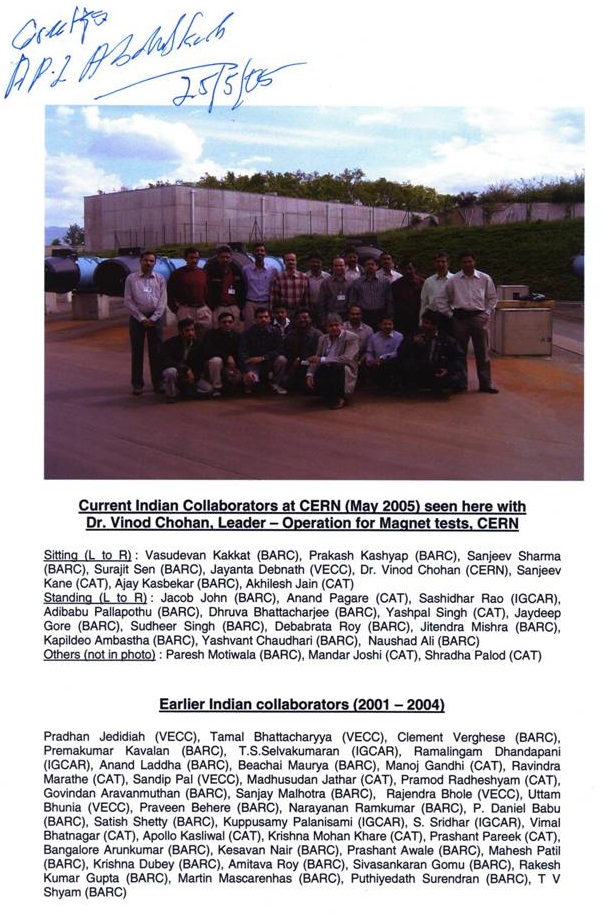
Professor Vinod Chohan was the first Indian origin person to join CERN (in 1975) and have been the longest staff member (40 years) before retirement in 2015. He made significant contributions to W and Z discovery in 1983 and tested all LHC magnets in the system thoroughly for quality assurance and training the magnets without which it would have never worked!

Other top Indian origin scientists at CERN include Professor Jim Virdee (joined in 1979), one of the founder members of the Compact Muon Solenoid (CMS) detector in the LHC and Professor Archana Sharma (joined in 1989), who is working on instrumentation especially gaseous detectors which are used in particle physics experiments like the Mega Experiment CMS at the Big Bang Machine LHC CERN.

Professor PK Malhotra from Tata Institute of Fundamental Research, Mumbai, worked on inclusive meson resonance production, universality of transverse momentum spectra and on direct and indirect production of pions, kanos and resonance at CERN. Professor Vikas Sinha of the Saha Institute of Nuclear Physics, Kolkata, designed a special chip that LHC used to process signals.

cern india

Indian universities sent not just senior scientists but also PhD students to CERN. These students lived and worked there for up to nine months every year, helping set up a lot of the crucial hardware and software in the machine.

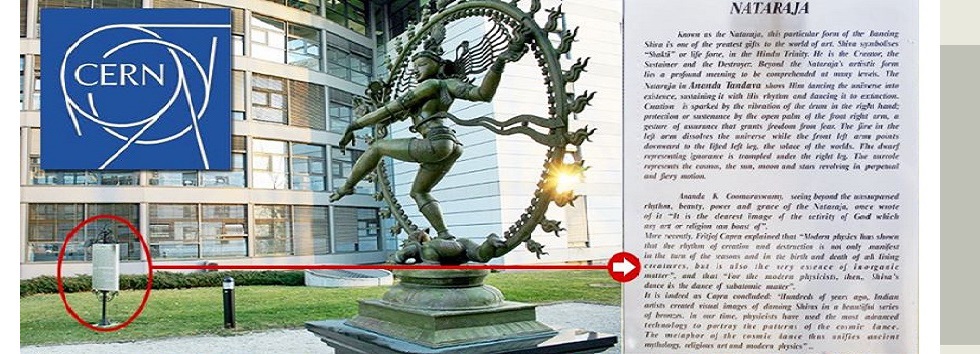
Finally, India’s Department of Atomic Energy gifted a two-metre bronze statue of the Nataraja to CERN on June 18, 2004.

What does Nataraja have to do with atoms? In an icon developed in south India by 9th and 10th century artists during the Chola period (880-1279 CE), Nataraja shows the Hindu God Lord Shiva dancing.

Nataraja is shown with four hands that represent the cardinal directions. The left foot is elegantly raised, the right foot tramples illusion and ignorance. The upper left hand holds a flame, The upper right hand holds an hourglass drum or ‘dumroo’.

It is believed Shiva’s drum produces the first sounds of creation. As ripples of sound course through matter, it comes alive and radiates all around Shiva. But even as he creates and makes matter alive, Shiva is dancing within a ring of fire, signifying the destruction he will soon bring about. In the Hindu religion, Nataraja represents the endless cycle of birth and death.

“Modern physics has shown that the rhythm of creation and destruction is not only manifest in the turn of the seasons and in the birth and death of living creatures but is also the very essence of inorganic matter. For modern physicists, Shiva’s dance is the dance of subatomic matter.” – Fritjof Capra in the book “The Tao of Physics”.

Further Reading:

  1. President of India Visit_CERN and Indian Collaborators
  2. Indian involvement in the LHC construction and physics possibilities that lie ahead
  3. Indian participation in LHC, SPL AND CTF-3 projects at CERN, Switzerland
  4. Operation for LHC Cryomagnet Tests : Concerns, Challenges & Successful Collaboration
  5. LHC Magnet Tests : Operational Techniques and Empowerment for Successful Completion

Reference and Credits: Part of this article was taken from IBN Blog authored by Jaimen Joseph. List of Indian collaborators signed by former Indian President Dr. APJ Abdul Kalam and five articles mentioned under ‘Further Reading’ above was provided by Dr. Vinod Chohan.