
Will update soon…
Category: Ancient India
Shiva’s Cosmic Dance at CERN
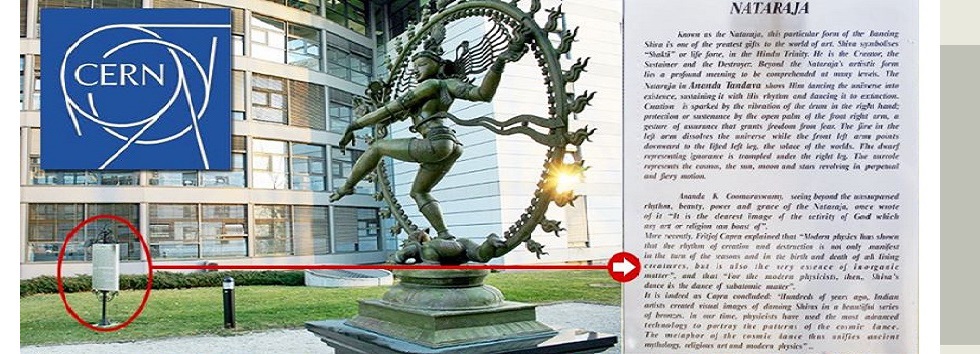
On June 18, 2004, an unusual new landmark was unveiled at CERN, the European Center for Research in Particle Physics in Geneva – a 2m tall statue of the Indian deity Shiva Nataraja, the Lord of Dance. CERN is Switzerland’s pre-eminent center of research into energy, the world’s largest particle physics laboratory and the place where core technologies of the internet were first conceived. The statue, symbolizing Shiva’s cosmic dance of creation and destruction, was given to CERN by the Indian government to celebrate the research center’s long association with India.
In choosing the image of Shiva Nataraja, the Indian government acknowledged the profound significance of the metaphor of Shiva’s dance for the cosmic dance of subatomic particles, which is observed and analyzed by CERN’s physicists. The parallel between Shiva’s dance and the dance of subatomic particles was first discussed by Fritjof Capra in an article titled “The Dance of Shiva: The Hindu View of Matter in the Light of Modern Physics,” published in Main Currents in Modern Thought in 1972. Shiva’s cosmic dance then became a central metaphor in Capra’s international bestseller The Tao of Physics, first published in 1975 and still in print in over 40 editions around the world.
A special plaque next to the Shiva statue at CERN explains the significance of the metaphor of Shiva’s cosmic dance with several quotations from The Tao of Physics. Here is the text of the plaque:
Ananda K. Coomaraswamy, seeing beyond the unsurpassed rhythm, beauty, power and grace of the Nataraja, once wrote of it “It is the clearest image of the activity of God which any art or religion can boast of.”
More recently, Fritjof Capra explained that “Modern physics has shown that the rhythm of creation and destruction is not only manifest in the turn of the seasons and in the birth and death of all living creatures, but is also the very essence of inorganic matter,” and that “For the modern physicists, then, Shiva’s dance is the dance of subatomic matter.”
It is indeed as Capra concluded: “Hundreds of years ago, Indian artists created visual images of dancing Shivas in a beautiful series of bronzes. In our time, physicists have used the most advanced technology to portray the patterns of the cosmic dance. The metaphor of the cosmic dance thus unifies ancient mythology, religious art and modern physics.”
References and relevant articles:
Takshashila: World’s First University
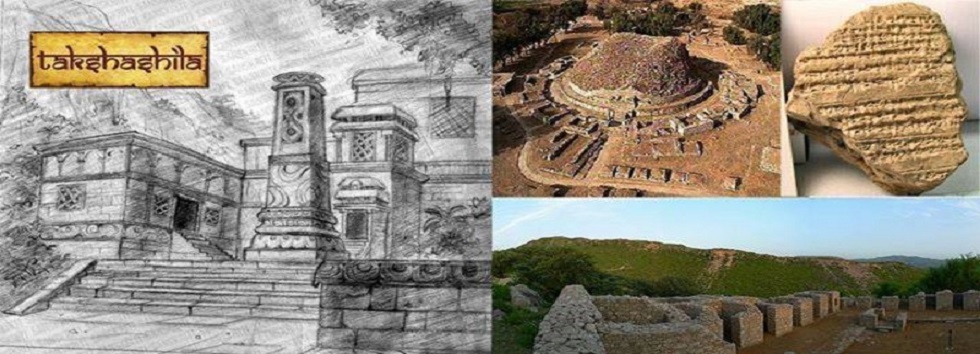
India has a long and venerable history in the field of higher education. In ancient times, the country was known to have been home to the oldest formal universities in the world. More than 2700 years back a huge university existed in that ancient India where over 10,500 students from all across the world came for higher studies.
This was the Takshila/TakshaShila university of ancient India (700 BC). During its times this university was the IIT and MIT of the world. During the 800 years that Takshila was operational, it attained great fame. The University consisted of
- 300 lecture halls with stones benches for sitting.
- Laboratories.
- Observatory called the Ambudharaavlehi for astronomical research.
- Massive Library called Dharma Gunj or Mountain of Knowledge.
- consisting of 3 buildings: Ratna Sagar, Ratnodavi and Ratnayanjak.
The Vayu Purana traces the start of Takshila to Taksha, son of Bharata and is also mentioned in Mahabharata, citing Dhaumya as one of the Acharyas. There are several mentions of this University in the Buddhist Jataka Tales. Chinese travellers like Fa Hian (Faxain) and Huien Tsang (XuanZang) also speak of Takshila in their writings.
COURSE AND CURRICULUM:
The university offered 68 different courses in various field such as science, mathematics, medicine, politics, warfare, astrology, astronomy, music, dance, religion, vedas, grammar, ayurveda, agriculture, surgery, commerce, futurology, and philosophy were taught by nearly 2000 master-teachers. There were even curious subjects like the art of discovering hidden treasure, decrypting encrypted messages, etc. The Vedas and the Eighteen Arts, which included skills such as archery, hunting, and elephant lore, were taught, in addition to its law school, medical school, and school of military science. Takshila was specialized in the study of medicine.
ADMISSION CRITERIA:
Students were admitted to this university at the age of 16 after they had completed their primary education at home (until the age of eight), and secondary education in the Ashrams (between the ages of eight and sixteen). Every single graduate who passed out of this university would become a well sought after scholar all across the subcontinent! Admission into this university was purely based on merit. The students would opt for electives and then would do indepth study and research into their field of choice. Entrance exam to Takshila was very difficult and only 3 out of every 10 students passed the admission test.
DIVERSITY!
More than 10,500 students from all over the world studied here. The campus accommodated students who came from as far as Babylonia (Iraq), Greece, Egypt, Syria, Asia Minor (Turkey), Arabia, and China.
AUTONOMOUS UNIVERSITY!
No external authorities like kings or local leaders subjected the scholastic activities at Takshashila to their control. Each teacher formed his own institution, enjoying complete autonomy in work, teaching as many students as he liked and teaching subjects he liked without confirming to any specific centralized syllabus. Study terminated when the teacher was satisfied with the student’s level of achievement. In most cases, the schools were located within the teachers’ private houses, and at times students were advised to quit their studies if they were unable to fit into the social, intellectual and moral atmosphere there. The teachers were exempted from the payment of taxes and they were given ample amounts of money on the the occasion of various sacrifices and rituals as well.

NO ADMISSION FEE!
Knowledge was considered too sacred to be bartered for money, and hence any stipulation that fees ought to be paid was vigorously condemned. Financial support came from the society at large, as well as from rich merchants and wealthy parents. Though the number of students studying under a single Guru sometimes numbered in the hundreds,teachers did not deny education even if the student was poor; free boarding and lodging was provided, and students had to do manual work in the household. Paying students like princes were taught during the day; non-paying ones, at night. Guru Dakshina was usually expected at the completion of a student’s studies, but it was essentially a mere token of respect and gratitude – many times being nothing more than a turban, a pair of sandals, or an umbrella. In cases of poor students being unable to afford even that, they could approach the king, who would then step in and provide something. Not providing a poor student a means to supply his Guru’s Dakshina was considered the greatest slur on a King’s reputation.
EXAMS NO CONSTRAINT!
Examinations were treated as superficial, not considered part of the requirements to complete one’s studies. The process of teaching was thorough- unless one unit was mastered completely, the student was not allowed to proceed to the next. No convocations were held upon completion, and no written degrees were awarded, since it was believed that knowledge was its own reward. Using knowledge for earning a living or for any selfish end was considered the ultimate Disaster.
ALUMNI: Takshashila’s famous researchers and teachers include
- Panini, the great grammarian of Sanskrit, to whom Prof. Noam Chomsky of MIT attributes the origin of linguistics. He was an expert in language and grammar and authored one of the greatest works on grammar ever written called Ashtadhyayi. Ashtadhyayi means eight chapters and is more complicated and at the same time highly technical and specific defining the features and rules of Sanskrit grammar, like how we have modern day books on computer programming languages like C/C++.
- Charaka, the famous ancient Indian ayurvedic physician was a product of Takshashila university. He originally authored the Charaka Samhita (simplifying an even older ayurvedic work called the Agnivesha Samhita) which along with Sushrutha Samhita, Ashtanga Sangraha and Ashtanga Hrudayam forms the root of modern Ayurveda. Charaka said, ‘A physician who fails to enter the body of a patient with the lamp of knowledge and understanding can never treat diseases’ .
- Jivak, was a doctor and an expert in pulse reading (understanding the health status of the body by just listening to the person’s pulse!). He studied Ayurveda in Takshashila University for seven years. His areas of specialization was Panchakarma, Marma and Surgery.Jivak was the personal physician of Buddha and also cured the Nadi Vran of Buddha! He also worked with the great classic beauty Amrapali and ensured that she retained her youthful countenance and performed many amazing operations on her using only Marma points and surgical procedures! He also invented a cure for Filariasis. There are over 15000 handwritten manuscripts of Jivak’s expertise passed on by generations to their children and are still preserved in India even today.
- Chanakya, the great political master also called Kautilya/Vishnugupta who not only authored the world’s finest work till today on political duties, statecraft, economic policies, state intelligence systems, administrative skills and military strategy, called the Artha Shastra which consists of 15 books, but who also guided Chandragupta Maurya as a mentor who founded the Great Mauryan Empire, and also served as the prime minister of the Mauryan Empire! In fact Chanakya is known to be the third most famous management consultant in India after Krishna and Shakuni.
- Vishnu Sharma , the author of the great book that teaches the art of political science in the form of simple beautiful stories called the Pancha Tantra (meaning the five techniques). It is said that Vishnu Sharma wrote these stories in order to convert three dumb princes of a king into able political administrators within a span of six months!
- Jotipala, son of the Purohita of the king of Banaras, returned from Takshashila with great proficiency in archery or military science and was later appointed commander-in-chief of Banaras.
- Prasenajit, the enlightened ruler of Kosala, who is intimately associated with the events of the time of the Buddha.
Takshila’s prosperity resulted from its position at the junction of three great trade routes. In the second half of the 5th century, it was severely damaged by Hephthalite invasions; during the 7th century it was gradually abandoned by its inhabitants. Excavations begun in 1913 finally gave the world a peak into the best minds in Indian history. Takshila was listed by the UNESCO as one of the World Heritage Sites in 1980.
As an ancient sanskrit quote says “स्वगृहे पूज्यते मूर्खः स्वग्रामे पूज्यते प्रभुः। स्वदेशे पूज्यते राजा विद्वान्सर्वत्र पूज्यते॥” (A fool is worshiped at his home. A chief is worshiped in his town. A king is worshiped in his kingdom. A knowledgeable person is worshipped everywhere)
References:
The Power of Global Meditation

If we want world peace it is up to us to make it manifest. The whole world is coming to the realisation that everything in the universe is connected. That our thoughts have real physical implications on our lives and the lives of those around us. No matter what Colour, Religion, or Country you are from, we are all Family. The sooner we embrace this Oneness we Will bring peace upon earth.
In 1978 what is known as the “Maharishi Effect” took a group of 7000 individuals over the course of 3 weeks and had them all meditating on thoughts of love and peace. They were able to radiate loving energy which reduced global crime rates, violence, and casualties during the times of their meditation by an average of 16%.
Suicide rates and automobile accidents also were reduced with all variables accounted for. In fact, there was a 72% reduction in terrorist during the times at which this group was meditation.
Almost 50 studies have been done further confirming the benefits of global meditation and it’s direct impact on everything in the world, even so far as to have the results published in the Journal of Crime and Justice in 1981. We know meditation has endless health and psychological benefits, but it is now being explored by politics and sociology because of its undeniable energetic impact.
Everything is energy, including your thoughts. These thoughts have a radiant quality that ripple through the consciousness field and energetically effect all things around you. If you want to change the state of society, it starts right now by finding peace and love within yourself.
“I think the claim can be plausibly made that the potential impact of this research exceeds that of any other ongoing social or psychological research program. It has survived a broader array of statistical tests than most research in the field of conflict resolution. This work and the theory that informs it deserve the most serious consideration by academics and policy makers alike.” — David Edwards Ph.D., Professor of Government, University of Texas at Austin.
Indian connection to the God particle
Indian connection to the God particle – From scientific expertise to Shiva’s dance.
“Who knows for certain? Who shall here declare it? Whence was it born, whence came creation? The gods are later than this world’s formation; Who then can know the origins of the world? None knows whence creation arose; And whether he has or has not made it; He who surveys it from the lofty skies, Only he knows- or perhaps he knows not” – The Rig Veda (X:129)
It’s being hailed as the biggest scientific discovery of the 21st century. After 50 years of searching – scientists have finally found the Higgs boson – commonly called the God particle. A Nobel prize winner, Leon Lederman, had actually called it the “God-damn” particle – because it was so bloody hard to find.
Scientists tracked it down thanks to the largest, most expensive experiment in history. Some would say it was an attempt to peek into the mind of God.
How was our universe, the stars and planets formed? To solve that big mystery, scientists began peering into small things. Into atoms and the small particles that form atoms. They wanted to find the smallest, most fundamental particle in nature.
Electrons, protons, neutrons – we’ve all learnt about all these in school. But scientists knew there were even smaller particles. They have a theory – called the Standard Model of Physics – that’s used to explain how everything in our universe works. According to the Standard Model, all matter is made of six fundamental particles. Over the past decades, scientists searched for and found five of those particles. The sixth – called the Higgs boson – they could never find.
That was a big problem. Because according to their theory – the Higgs boson gives mass to all matter. Without mass, electrons, protons, neutrons and all other particles would never combine. If they wouldn’t combine, atoms would not be formed, nor would larger things like the sun, moon, earth, the galaxies and our universe. You and I would never exist.
Since it was such an important particle, scientists looked really hard for it – for almost fifty years. When they couldn’t find it, they began to wonder if their theories were wrong. If their explanations about our world were somehow flawed.
Searching for such small things is really expensive business. It costs $10 billion, to be precise. That’s what it took to build the Large Hadron Collider or LHC. It’s a 27-kilometre-long underground tunnel in the shape of a ring, built by the Conseil Européen pour la Recherche Nucléaire or CERN . The tunnel crosses the borders of both France and Switzerland.
Inside the tunnel, scientists accelerate protons, or tiny subatomic particles – to just under the speed of light. Then they crash these protons against each other. – breaking them up into trillions of smaller, tinier particles. Sensors inside the tunnel record those particles and computers around the world slowly sift through the data, trying to identify traces of the Higgs boson.
Interestingly, the Higgs in “Higgs boson” comes from Peter Higgs, the British scientist who in 1964, first suggested that such a particle existed. But Boson, is named after Satyendra Nath Bose, an Indian statistical physicist who was a contemporary of Albert Einstein. His equations helped prove Max Planks Law – a theory that says light has a dual nature. It moves in discrete packets, even as it moves in a wave.
But the Indian connection doesn’t end there. Of more than 2000 scientists working at The Large Hadron Collider, at least 200 were from India. India also contributed almost $25 million to the project.
There’s more. Inside the 27 kilometre long tunnel are almost 1,232 cryo-magnets, that are crucial for accurately guiding protons around the ring. Each magnet weighs almost 35 tonne and each sits on extremely accurate motion positioning systems developed, among other places, at the Raja Ramanna Centre for Advanced Technology (RRCAT) in Indore, India.
Delhi University developed special sensors for the Compact Muon Solenoid or CMS detector inside the tunnel. CMS played a crucial role in ultimately detecting the Higgs boson.
Indian institutes like Tata Institute of Fundamental Research (TIFR), Mumbai; Bhabha Atomic Research Centre (BARC), Trombay; Saha Institute of Nuclear Physics (SINP), Kolkata; RRCAT, Indore; Benares Hindu University and the universities of Delhi, Jaipur and Punjab were connected to CERN in Geneva by fibre optic cables.
They were part of a new, super-fast, worldwide Internet called the grid – which was used to analyse data from the experiment. Almost 15 petabytes of data (1 petabyte is quadrillion bytes or 1,000 terabytes) was generated every year at CERN. If that data was recorded on CDs and stacked up, it would form a pile of compact discs 12 miles high. Distributing it among universities in India and elsewhere, helped process the data faster.
Professor Vinod Chohan was the first Indian origin person to join CERN (in 1975) and have been the longest staff member (40 years) before retirement in 2015. He made significant contributions to W and Z discovery in 1983 and tested all LHC magnets in the system thoroughly for quality assurance and training the magnets without which it would have never worked!
Other top Indian origin scientists at CERN include Professor Jim Virdee (joined in 1979), one of the founder members of the Compact Muon Solenoid (CMS) detector in the LHC and Professor Archana Sharma (joined in 1989), who is working on instrumentation especially gaseous detectors which are used in particle physics experiments like the Mega Experiment CMS at the Big Bang Machine LHC CERN.
Professor PK Malhotra from Tata Institute of Fundamental Research, Mumbai, worked on inclusive meson resonance production, universality of transverse momentum spectra and on direct and indirect production of pions, kanos and resonance at CERN. Professor Vikas Sinha of the Saha Institute of Nuclear Physics, Kolkata, designed a special chip that LHC used to process signals.
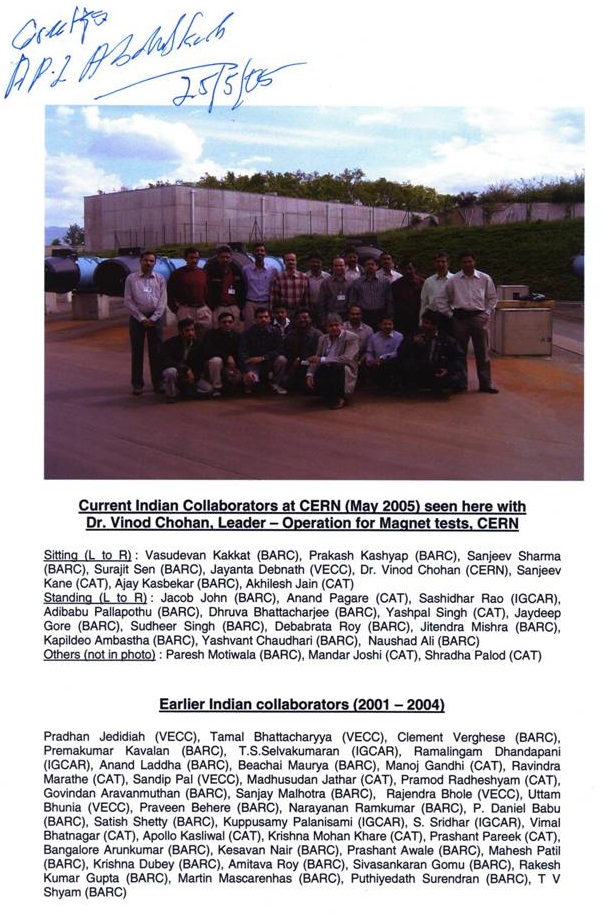
Indian universities sent not just senior scientists but also PhD students to CERN. These students lived and worked there for up to nine months every year, helping set up a lot of the crucial hardware and software in the machine.
Finally, India’s Department of Atomic Energy gifted a two-metre bronze statue of the Nataraja to CERN on June 18, 2004.
What does Nataraja have to do with atoms? In an icon developed in south India by 9th and 10th century artists during the Chola period (880-1279 CE), Nataraja shows the Hindu God Lord Shiva dancing.
Nataraja is shown with four hands that represent the cardinal directions. The left foot is elegantly raised, the right foot tramples illusion and ignorance. The upper left hand holds a flame, The upper right hand holds an hourglass drum or ‘dumroo’.
It is believed Shiva’s drum produces the first sounds of creation. As ripples of sound course through matter, it comes alive and radiates all around Shiva. But even as he creates and makes matter alive, Shiva is dancing within a ring of fire, signifying the destruction he will soon bring about. In the Hindu religion, Nataraja represents the endless cycle of birth and death.
“Modern physics has shown that the rhythm of creation and destruction is not only manifest in the turn of the seasons and in the birth and death of living creatures but is also the very essence of inorganic matter. For modern physicists, Shiva’s dance is the dance of subatomic matter.” – Fritjof Capra in the book “The Tao of Physics”.
Further Reading:
- President of India Visit_CERN and Indian Collaborators
- Indian involvement in the LHC construction and physics possibilities that lie ahead
- Indian participation in LHC, SPL AND CTF-3 projects at CERN, Switzerland
- Operation for LHC Cryomagnet Tests : Concerns, Challenges & Successful Collaboration
- LHC Magnet Tests : Operational Techniques and Empowerment for Successful Completion
Reference and Credits: Part of this article was taken from IBN Blog authored by Jaimen Joseph. List of Indian collaborators signed by former Indian President Dr. APJ Abdul Kalam and five articles mentioned under ‘Further Reading’ above was provided by Dr. Vinod Chohan.
 Dr. Harshavardhan Reddy Pinninty