How lasers revealed a lost city?

Deep in the Cambodian jungle lie the remains of a vast medieval city, which was hidden for centuries. New archaeological techniques are now revealing its secrets – including an elaborate network of temples and boulevards, and sophisticated engineering.

Angkor Wat temple

In April 1858 a young French explorer, Henri Mouhot, sailed from London to south-east Asia. For the next three years he travelled widely, discovering exotic jungle insects that still bear his name. Today he would be all but forgotten were it not for his journal, published in 1863, two years after he died of fever in Laos, aged just 35.

Mouhot’s account captured the public imagination, but not because of the beetles and spiders he found. Readers were gripped by his vivid descriptions of vast temples consumed by the jungle: Mouhot introduced the world to the lost medieval city of Angkor in Cambodia and its romantic, awe-inspiring splendour.

“One of these temples, a rival to that of Solomon, and erected by some ancient Michelangelo, might take an honourable place beside our most beautiful buildings. It is grander than anything left to us by Greece or Rome,” he wrote. His descriptions firmly established in popular culture the beguiling fantasy of swashbuckling explorers finding forgotten temples.

Today Cambodia is famous for these buildings. The largest, Angkor Wat, constructed around 1150, remains the biggest religious complex on Earth, covering an area four times larger than Vatican City. It attracts two million tourists a year and takes pride of place on Cambodia’s flag. But back in the 1860s Angkor Wat was virtually unheard of beyond local monks and villagers. The notion that this great temple was once surrounded by a city of nearly a million people was entirely unknown. It took over a century of gruelling archaeological fieldwork to fill in the map. The lost city of Angkor slowly began to reappear, street by street. But even then significant blanks remained. Then, last year, archaeologists announced a series of new discoveries – about Angkor, and an even older city hidden deep in the jungle beyond.

An international team, led by the University of Sydney’s Dr Damian Evans, had mapped 370 sq km around Angkor in unprecedented detail – no mean feat given the density of the jungle and the prevalence of landmines from Cambodia’s civil war. Yet the entire survey took less than two weeks.

Their secret?

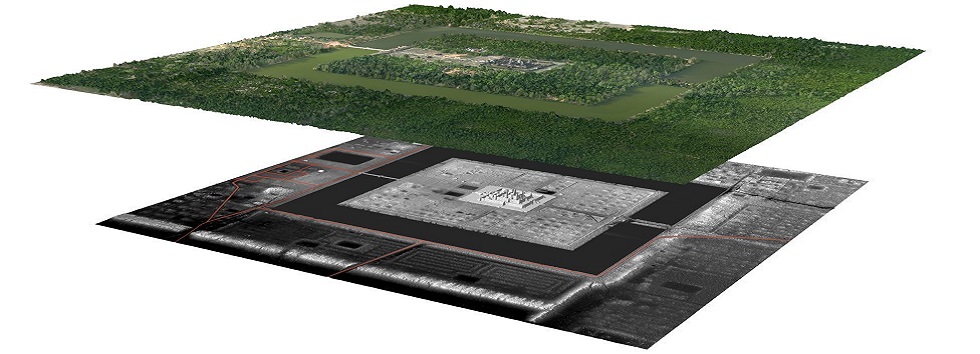
Lidar – a sophisticated remote sensing technology that is revolutionising archaeology, especially in the tropics. Mounted on a helicopter criss-crossing the countryside, the team’s lidar device fired a million laser beams every four seconds through the jungle canopy, recording minute variations in ground surface topography. The findings were staggering.

Image showing what is beneath the ground at Angkor
Lidar technology has revealed the original city of Angkor – red lines indicate modern features including roads and canals

The archaeologists found undocumented cityscapes etched on to the forest floor, with temples, highways and elaborate waterways spreading across the landscape. “You have this kind of sudden eureka moment where you bring the data up on screen the first time and there it is – this ancient city very clearly in front of you,” says Dr Evans. These new discoveries have profoundly transformed our understanding of Angkor, the greatest medieval city on Earth.

Phra Sav Ling Povn, palace of the leprous king, near the great temple of Angkor Wat, circa 1930
Phra Sav Ling Povn, palace of the leprous king, near Angkor Wat, circa 1930

At its peak, in the late 12th Century, Angkor was a bustling metropolis covering 1,000 sq km. (It would be another 700 years before London reached a similar size.)

Angkor was once the capital of the mighty Khmer empire which, ruled by warrior kings, dominated the region for centuries – covering all of present-day Cambodia and much of Vietnam, Laos, Thailand and Myanmar. But its origins and birthplace have long been shrouded in mystery.

A few meagre inscriptions suggested the empire was founded in the early 9th Century by a great king, Jayavarman II, and that his original capital, Mahendraparvata, was somewhere in the Kulen hills, a forested plateau north-east of the site on which Angkor would later be built.

But no-one knew for sure – until the lidar team arrived. The lidar survey of the hills revealed ghostly outlines on the forest floor of unknown temples and an elaborate and utterly unexpected grid of ceremonial boulevards, dykes and man-made ponds – a lost city, found.

Relief map of Mahendraparvata

Most striking of all was evidence of large-scale hydraulic engineering, the defining signature of the Khmer empire.

By the time the royal capital moved south to Angkor around the end of the 9th Century, Khmer engineers were storing and distributing vast quantities of precious seasonal monsoon water using a complex network of huge canals and reservoirs. Harnessing the monsoon provided food security – and made the ruling elite fantastically rich. For the next three centuries they channelled their wealth into the greatest concentration of temples on Earth.

One temple, Preah Khan, constructed in 1191, contained 60t of gold. Its value today would be about £2bn ($3.3bn). But despite the city’s immense wealth, trouble was brewing. At the same time that Angkor’s temple-building programme peaked, its vital hydraulic network was falling into disrepair – at the worst possible moment.

The end of the medieval period saw dramatic shifts in climate across south-east Asia. Tree ring samples record sudden fluctuations between extreme dry and wet conditions – and the lidar map reveals catastrophic flood damage to the city’s vital water network. With this lifeline in tatters, Angkor entered a spiral of decline from which it never recovered.

In the 15th Century, the Khmer kings abandoned their city and moved to the coast. They built a new city, Phnom Penh, the present-day capital of Cambodia. Life in Angkor slowly ebbed away.

Angkor Wat

When Mouhot arrived he found only the great stone temples, many of them in a perilous state of disrepair. Nearly everything else – from common houses to royal palaces, all of which were constructed of wood – had rotted away. The vast metropolis that once surrounded the temples had been all but devoured by the jungle.

Reference: http://www.bbc.com/news/magazine-29245289

Photonics is everywhere!

Photonics technologies are amazing, fascinating, and you find them everywhere: in communication, entertainment, medical, manufacturing, automotive, energy, lighting, agriculture, photovoltaic, security, art, … Whether you are looking for a new career, a student that needs to make a choice for your studies, if you are a financial investor or a politician that influences policies, think PHOTONICS !

++++++++++++++++++++++++++++++++++++++++++++++++++++++++

A day without Photonics

Why all the hoopla about light, lasers, optics and photonics? Why does light and our relatively recent capacity to make it do what we want it to do matter so much? Why is “Waves and their applications in technologies for information transfer” one of the relatively few content areas defined in the Next Generation Science Standards? Because our understanding of light and waves is the foundation for the technology behind so many of the 21st century essentials: cell phones, data storage, medical imaging, just to name a few. Check out this humorous and telling video by SPIE about the horror of imagining just a single day without photonics or the modern conveniences it makes possible!

+++++++++++++++++++++++++++++++++++++++++++++++++++++++++++

Happy International Year of Light 2015! 

lYL 2015

The International Year of Light is a global initiative which will highlight to the citizens of the world the importance of light and optical technologies in their lives, for their futures, and for the development of society. It is an unique opportunity to inspire, educate, and connect on a global scale.

On 20 December 2013, The United Nations (UN) General Assembly 68th Session proclaimed 2015 as the International Year of Light and Light-based Technologies (IYL 2015).

This International Year has been the initiative of a large consortium of scientific bodies together with UNESCO, and will bring together many different stakeholders including scientific societies and unions, educational institutions, technology platforms, non-profit organizations and private sector partners.

In proclaiming an International Year focusing on the topic of light science and its applications, the United Nations has recognized the importance of raising global awareness about how light-based technologies promote sustainable development and provide solutions to global challenges in energy, education, agriculture and health. Light plays a vital role in our daily lives and is an imperative cross-cutting discipline of science in the 21st century. It has revolutionized medicine, opened up international communication via the Internet, and continues to be central to linking cultural, economic and political aspects of the global society.

Light up the passion for Photonics

Termed as the technology of 21st century, photonics holds promise of a great career for those with love for physics.

In an era when LED bulbs, fibre optic cables, scanners and lazers are so much a part of the equipment we use, it is surprising that there are not enough people getting into Photonics —  one of the fastest growing high-tech industries in the world today. Photonics is a discipline of physics that deals with the study of photons, the primary particle of light, to obtain, convey or process information. It is the science of mastering the techniques involved in the emission, detection, transmission and modulation of light. Due to the advent of sophisticated equipment and new techniques photonics is considered to be the next generation technology. In fact, just as electronics is considered the technology of the 20th century, photonics could be the technology of the 21st century. Photonics has become a fundamental technology in worldwide telecommunication, computing, security and many other applications because of its advantage to work more effectively and with much greater speed. The growing numbers of practical applications of photonics make it an important field both for research and commercial development. The technology is used for imaging, health care and medicine, defence, optics and electronics. It deals with the instruments required such as laser guns, optical fibers, optometric instruments etc. in numerous and diverse fields of technology. These include:

  • Optical communications (e.g., fiber optics, lasers, and infrared links),
  • Optical imaging (e.g., spy and weather satellites, night vision, holography, flat screen display,  and  CCD video cameras),
  • Optical data storage and optical computing (e.g., CDs and DVDs),
  • Optical detectors (e.g., supermarket scanners, medical optics, and nondestructive evaluation of materials),
  • Lasers (e.g., welding lasers, laser surgery, laser shows, and laser rangefinders)
  • Spectroscopy (e.g., chemical and biological detection, anti-terror detection) and many others.

Getting in

The eligibility criteria for taking up a graduation course in photonics or optoelectronics is Plus II with physics, chemistry and maths and a minimum mark of 55 per cent. Although photonics industry is growing rapidly, photonics companies have a hard time finding qualified people because there are limited courses that cover this subject, as it is an interdisciplinary field covering physics, physical chemistry, and electrical engineering. For those unaware of this course, a degree in applied physics, science, or engineering can enable you to get into this field. A candidate having a bachelor in physics and mathematics, Applied physics or electronics can pursue MSc in photonics or optoelectronics. One can also obtain MTech, MPhil, and PhD in photonics and the eligibility is a master’s degree in physics or photonics. There are also some diploma courses that can enable you to become a photonics technician. The two-year technician programme teaches you the practical skills required to get into this field. Most courses in photonics or optoelectronics include the study of modern optics, laser technology systems and applications, optoelectronic and optical communications, microprocessor and micro controller, fiber optics communication and sensor, digital signal processing, photonic materials and devices.

Job prospects

Career options in this field are virtually limitless, as they cover almost every area of science and technology, from energy generation and detection to communication, manufacturing, healthcare and information processing. Most of the jobs for photonics specialists are with telecommunication companies, and with R & D organisations involved in the area of networks, semiconductor technology, fiber and integrated optics, optoelectronics and software. There are many jobs in the design and manufacture of semiconductor light sources like light-emitting and super luminescent diodes (LEDs and SLDs), fluorescent lamps, cathode ray tubes (CRTs), and plasma display panels (PDPs), used in television sets, computer monitors, mobile phones and computers, handheld video game systems, personal digital assistants, navigation systems, and projectors.Other job options could vary from that of a bio-chemist performing in vivo fluorescence and Raman spectroscopy on various cancer tumors, to a technical manager in a start-up company developing a new needle-free optical glucose monitoring device for people with diabetes, or a mechanical engineer working on a design of new automated systems for fiber alignment used in fiber-components manufacturing.The pervasive and far-reaching applications of this technology, along with its multidisciplinary characteristic, open tremendous career opportunities to qualified people in the field. So whether you have done physics, chemistry, bio-chemistry, computer science, electrical, mechanical or industrial engineering you can take up the optics and photonics specialisation to move into the field of photonics. What you do require to have is:

  • A fascination for science and related topics.
  • An eye for detail.
  • Curiosity for solving science-centered questions.
  • Be good in physics and mathematics.
  • Some out of the box thinking as you need to design equipments.

As  more and more applications of optics and photonics emerge, the demand for qualified people  is only going to grow.  So, if you can see that ray of light in photonics it may be the best way forward for you.

This article was first published by Usha in The Tribune India